In today's world, where environmental concerns are paramount, power distribution is one of the most visible places to make infrastructure cleaner. Overhead lines are functional and economical, but they bring visual clutter, exposure to storms and falling trees, and risks to birds and to the public. Underground cabling replaces poles and bare conductors with buried cable: a cleaner, safer and more weather-resilient network.
It is not automatically the right answer everywhere. This guide covers what underground wiring improves, what it costs, and how a well-built underground network is actually delivered on site.
Benefits of underground wiring
- Cleaner streets and skylines. Removing poles, crossarms and tangled conductors frees footpaths and road verges and gives dense neighbourhoods room to breathe.
- Better reliability in bad weather. Buried cable is not exposed to wind, falling branches and trees, or vehicles striking poles, so weather-related interruptions are typically fewer than on an equivalent overhead line.
- Safer for people. There are no live conductors overhead that can fall, be touched by a ladder, kite string or crane jib, or be brought down in a road accident.
- Lower impact on wildlife and trees. Birds and bats are no longer exposed to bare overhead conductors, and corridors no longer need repeated tree trimming to keep lines clear.
- More usable space. In congested areas, undergrounding releases land at the roadside for road widening, drainage, footpaths and street furniture.
What to weigh up
An honest case for underground wiring also covers its trade-offs:
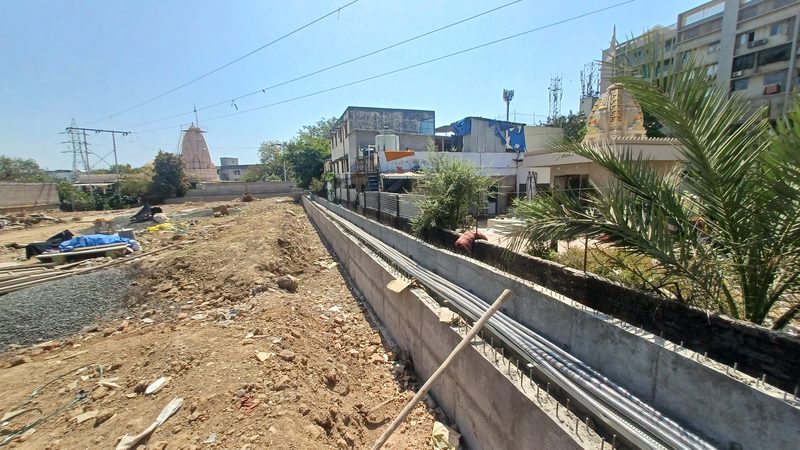
- Higher upfront cost. Trenching, ducting, jointing and reinstatement cost more than erecting poles and stringing conductor.
- Faults are harder to find. A buried cable fault cannot be seen from the road. Cable fault locators, and accurate records of every joint, are what turn a long outage into a short one.
- Third-party damage is a main threat. Damage from other people's excavation is one of the leading causes of underground faults, which is why route survey, utility detection and clear route marking matter as much as the cable itself.
- Workmanship decides the outcome. A cable is only as reliable as its joints and terminations, which must be made by qualified jointers using approved kits under controlled conditions.
How an underground network is built
- Route survey and utility detection. The route is walked and scanned with electromagnetic locators to map existing water, gas, telecom and power services before anyone digs. Where there is a conflict, the alignment is revised or the crossing is redesigned.
- Trenching, bedding and ducting. Trenches are cut to the depth and width specified for the voltage class and bedded with screened sand, and cables are laid with correct spacing and bending radius. Protective covers and warning tape go in before layered, compacted backfill.
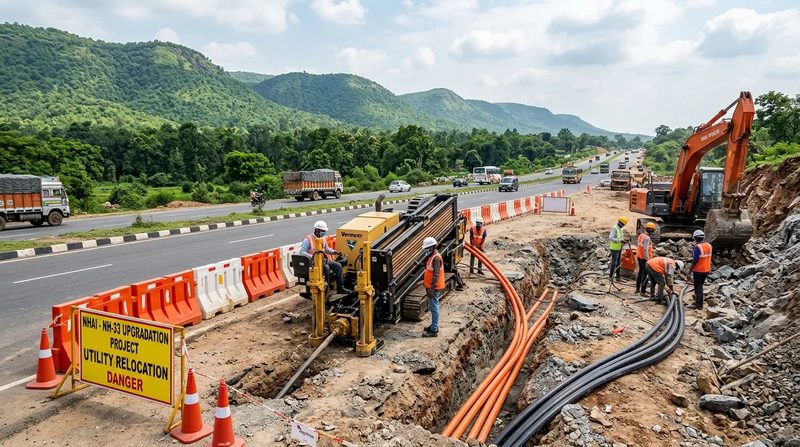
- Trenchless crossings. Roads, drains and rail-side land can be crossed by horizontal directional drilling (HDD): a pilot bore is steered beneath the obstacle and the duct bundle pulled through, so the carriageway does not have to be cut.
- Jointing and termination. HT joints and terminations are made with manufacturer-approved kits, and every joint is recorded with its location so a future fault can be traced to a known point.
- RMUs and DTRs on engineered foundations. Ring main units and distribution transformers are placed at the points where cables terminate and power is switched or stepped down.
- Testing and energisation. Before charging, cables undergo insulation resistance and high-voltage withstand testing and the earthing is measured. Energisation proceeds only on a cleared permit with signed-off test records.
Where RMU and DTR foundations fit
In an underground network, ring main units (RMUs) and distribution transformers (DTRs) are where the buried cables terminate and where power is switched or stepped down for local supply. Each sits on a foundation: a plinth cast to utility-approved drawings with cable entry provision, duct sleeves and earthing pits set into the pour. The foundation carries the equipment, and the cables reach it through the ducts. Getting this right at the casting stage avoids termination problems later. Read more in The Crucial Role of RMU & DTR Foundations.
Overhead-to-underground conversion with Royal Infra Projects
Royal Infra Projects delivers overhead-to-underground conversion of 11kV distribution networks, including the RDSS-programme conversion at Bopal and the network conversion at Sanand for UGVCL, executed through our channel partners L&T Construction and Rajesh Power Services Ltd. The civil, route and plant-based scope runs on our own crews and equipment, including HDD machines, utility locators and cable fault-locating sets. Licensed electrical installation, jointing, termination, testing and commissioning are carried out by our licensed electrical contracting partners under our project management. See the Projects page for detail.
In short
Underground wiring gives cleaner streets, safer public spaces and a network that is far less exposed to the weather. It asks for more upfront investment and careful workmanship, which is why survey, trenching, jointing, testing and foundations all have to be done properly. If you are planning a conversion or a new underground network, talk to our team.